 English
 Français
 Deutsch
 Русский
 Italiano
 Español
 Português

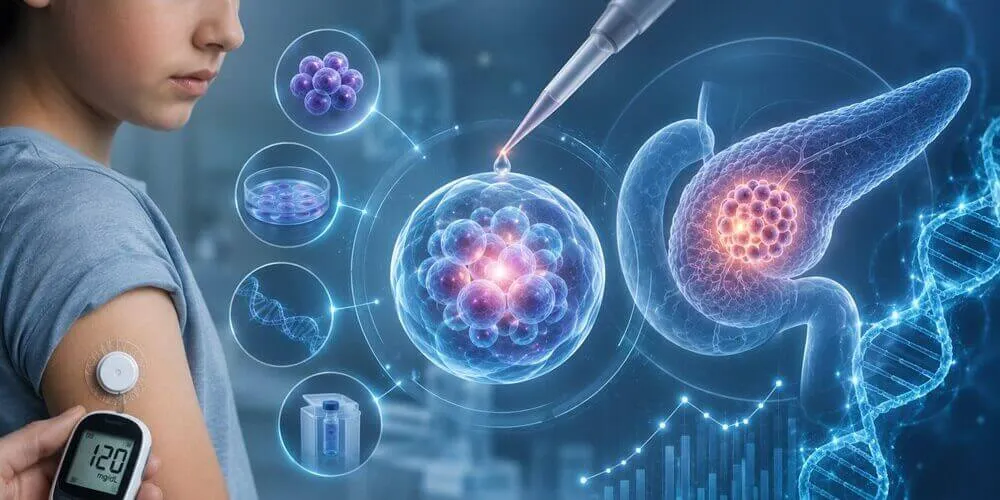
The aim of stem cell therapy for Type 1 diabetes is to restore adequate insulin production and reduce insulin dependence in order to mitigate the short-term and long-term complications of the disease. This is achieved by replacing the destroyed insulin-producing β cells of the pancreas, restoring the endogenous regulation of blood glucose levels and, when possible, modulating the autoimmune attack against the pancreatic β cells.
What is the main aim of stem cell therapy for Type 1 diabetes?
Clinically, the ultimate goal is to restore normal C-peptide levels and reduce exogenous insulin requirements. Several clinical trials have investigated the efficacy of β cell replacement therapies. Those with the most favorable outcomes and safety profiles highlight the potential for allogeneic therapy combined with immunoprotective strategies. Depending on the study, treatment success has been defined either as maintaining blood glucose control without severe hypoglycemic events and with functional C-peptide production or reduction of insulin needs by more than fifty percent in the case of insulin independence.
How does beta cell replacement therapy work in simple terms?
Beta cell replacement therapy aims to supply functional beta cells in sufficient quantity and quality to meet physiological demands, avoiding or overcoming the immune-related or non-immune-mediated destruction that leads to graft dysfunction in established Type 1 diabetes. Human pluripotent stem cells, including embryonic stem cells and induced pluripotent stem cells, provide an unlimited, renewable source of functional beta-like cells. These cells can be generated through differentiation protocols that recapitulate several stages of beta cell development. Following differentiation, minor lineage-specific gene expression signatures can be used to confirm generation of the desired cell type while functional maturation, especially for autologous beta-like cells, continues to be an area of intense investigation.
To restore physiological beta cell function, an adequate number of cells must also be supplied to ensure stable function in vivo. Transplantation of stem cell-derived beta-like cells into intraportal or intra-axillary adipose depot sites enables functional engraftment and islet-like vascularization, thereby allowing glucose-regulated release of insulin. Upon infusion of sufficient numbers of cells, physiological regulation of glycemia should be restored while concomitantly modulating postprandial glucagon secretion from alpha cells. Ultimately, these cells should maintain long-term function (>1 year) while remaining free from immune or non-immune-mediated dysfunction.
What are stem cell-derived islet cells and how are they made?
Functional beta-like cells capable of controlling blood glucose concentrations can be generated from pluripotent stem cells. These cells may be supplied in the form of fully functional, matured islet cells or as a mixture of progenitors under specific conditions. Multiple differentiation protocols exist, most leading to a globally similar identity, and an increasing toolkit of functional markers enables robust characterization. Rigorous manufacturing processes assure reproducibility across different laboratories. Moreover, platforms for dedicated production of the choicest cell preparations suitable for clinical application are coming online, supported by thorough batch testing.
A major advance in stem cell-derived regenerative therapy for patients with Type 1 diabetes is the development of protocols that yield large numbers of functional islet cells that closely mimic the properties of pancreatic islets and their major architectonic organization into the three pancreatic major cell types, i.e., beta, alpha, and PP-cells. Pluripotent stem cells are first converted into pancreatic progenitors, then into endocrine progenitors, and thereafter into pancreas-like organoids composed of endocrine progenitors that are subsequently matured into functional islets. Relevant endocrine hormones secreted in the correct ratio in response to glucose and potassium stimuli surge in the media. Stem cell-derived islets are suitable for large-scale manufacture, with batch testing for insulin, intact glucagon, and insulin to glucagon ratio—important for in vitro quality control—and stain for all major cells as indicative of in vivo functionality.
What is the current status of regenerative medicine for Type 1 diabetes?
Stem cell-based regenerative medicine for Type 1 diabetes is entering an exciting stage. Mounting evidence emerges from clinical trials of candidate therapies, including restoration of endogenous insulin production via beta cell replacement therapy and rejuvenation of the diabetic milieu to mitigate autoimmunity. Evidence to date supports the safety and feasibility of many approaches but not their efficacy. An established framework now links laboratory discoveries to clinical application.
Key signals thus far originate primarily from clinical-stage candidate therapies and include allogeneic beta cell therapies based on pluripotent stem cell differentiation and encapsulation, immune-protective measures directed at preventing rejection, and combinatorial regimens fostering innate tolerance. Recent progress on the generation of stem cell-derived islet cells further refines the manufacturing process, while developments in quality and burn-down assurance hold promise for long-term graft durability. Preparations based on entirely different technology platforms—such as endogenous regeneration—now join the fray.

What advances exist in Type 1 diabetes stem cell treatment as of 2026?
Evidence, Technologies, and Exciting Approaches
Therapeutic beta cell replacement therapy remains the primary goal of stem cell therapy for people with Type 1 diabetes. Compared with previous reports, new strategies to protect the transplants and improve how they are made show promise. Therapies that restore endogenous insulin production and reduce insulin dependence are available in clinical trials or awaiting regulatory approval. Recent years have seen the emergence of regenerative medicine approaches that rebuild tissue in situ rather than through transplantation, and some harness combinations of stem cells and other techniques to achieve an overall cure.
The most advanced efforts focus on restoring insulin production via translational beta cell replacement therapy in current or recalcitrant patients. Capitalising on this rapid progress, a small group of teams is using stem-cell-derived islet cells to repair — rather than replace — the damaged beta cell population and provide patients with a more comfortable experience. Improvements in differentiation protocols promise to increase the maturation, functional viability, and cellular purity of stem-cell-derived islet products. Furthermore, studies by several groups have pointed to more mature beta-like cell transplants with greater functional endurance.
How do emerging diabetes stem cell treatments compare to old methods?
Emerging diabetes stem cell treatments offer marked improvements over older methods. Comparative analysis draws on reported clinical evidence to clarify superior aspects of new approaches concerning practical, clinical, and scientific criteria. Approved therapies based on allogeneic grafts confer clinical benefit with acceptable safety. Immune-protective strategies reduce or eliminate the need for chronic immunosuppression, with an associated improvement in patient experience. By contrast, the limitations of conventional therapies—including the requirement for continuous, lifelong intervention and the risk of severe hypoglycemia—remain unaddressed. Consequently, treatment by in situ beta cell regeneration represents a more desirable option, provided it can be achieved in the near future.
Although patients with Type 1 diabetes requiring exogenous insulin would benefit from exogenous therapy, the cost, complexity, risks, and inconveniences associated with such treatment are considerable. The vast experience gained with allogeneic therapies accentuates these shortcomings. It is to be hoped that, within a reasonable timeframe, the continuous necessity for exogenous insulin, with its associated dangers, can be eliminated. Reducing the need for chronic, life-long immunosuppression further improves the safety profile of advanced treatments, reducing the risk of secondary infections, allowing more vigorous vaccination, and enabling therapy for hematological malignancies without the risk of graft-versus-host disease.
What are the challenges in stem cell diabetes research 2026?
Despite the remarkable progress in recent years, several scientific, clinical, and ethical challenges remain to be addressed before stem cell-derived therapies for T1D can be used safely in patients. Among the most important hurdles are immune rejection of implanted allogeneic products, the risk of tumourigenicity in recipients of pluripotent stem cell-derived cells, quality control (particularly for stem cell-derived islet cells), and the need for large-scale, cost-effective production. Other issues include the ability to provide sufficient numbers of product batches for worldwide demand; ensuring that the needs of highly vulnerable patients—such as very young children and pregnancy-associated cases—are prioritised; and the provision of such therapies at reasonable cost, in a fair manner, and with equitable access for those in need.
Insulin-dependent diabetes induced by autoimmune response is mainly treated with exogenous insulin therapy. As patients age, more severe episodes of hypoglycaemia develop, while, in some patients, the frequency of episodes increases. Some patients reach a stage where conventional therapy is ineffective, and the living conditions are extremely poor. For these patients, cell therapy seems the best alternative. For T-cell-therapy patients, a clinical trial has commenced, where stem-cell-derived islet-like cells can provide potential solutions through T-cell modulation. For diabetic patients who are diagnosed at a very young age, stem-cell-derived islet-transplant procedure for T1D patients can help, but is far over the reach. Hence it will be acted upon later, when anaesthesia and surgery become safer for very young children. These considerations help T1D patients have a better quality of life.
How is safety addressed in stem cell therapy for Type 1 diabetes?
Safety remains paramount in stem cell therapy for Type 1 diabetes, with stringent processes to ensure recipient well-being. Before human trials, extensive preclinical safety assessments characterize candidate therapies, highlighting risks and supporting risk mitigation strategies. For beta cell replacement therapy, overseers monitor graft survival and functionality through the critical early phase and oversee individuals’ health for adverse events. Current trials report encouraging safety profiles, and long-term follow-up plans encompass recipients of approved products. Further long-term monitoring will identify late-emerging concerns, with post-marketing studies mandated by regulatory agencies. Ethical principles guide investigator conduct and participant interaction.
Therapeutic efficacy must be shown and undisclosed risks monitored. Foundation techniques now track graft survival; future innovations may present earlier, more scalable methods and additional safety parameters. Preclinical work identifes potential toxicities arising from graft or product application and addresses them. Scrutiny must extend beyond the product to its manufacture and delivery, ensuring that stem cell therapies fulfil access expectations without safety compromises.
Who might benefit most from stem cell derived therapies?
Consequently, subgroups of patients who might benefit most from stem cell-derived therapies can be delineated, along with the dysfunctions and conditions that predispose them to poor clinical outcomes. Candidates are those with substantially impaired endogenous insulin production, who experience recurrent episodes of severe hypoglycemia or hypoglycemia unawareness, or who have lost control of metabolic parameters with conventional therapy. In general, an age at disease onset between 10 and 40 years is associated with a therapeutic window of opportunity, with interval since diagnosis low or moderate, a lower autoimmunity burden, and the absence of chronic complications being favourable conditions. Access to specialized treatment centres that guarantee thorough clinical evaluation and careful counselling before and after the procedure also greatly influences therapy outcomes.
Patients with type 1 diabetes who fulfill these characteristics should ideally be treated during a narrow time window, when the risk of serious problems due to complications or related conditions is increasing, with reduced quality of life or refractoriness to available therapies. These criteria should not be interpreted as exclusionary, since a broader indication remains equally desirable: Patients at greater metabolic risk, with advanced chronic complications, or who are outside these categories can often be treated safely, and successful outcomes have been reported even in the presence of multiple comorbidities.
What is the future outlook for stem cell therapy for Type 1 diabetes?
Over the next five years, stem cell therapy for Type 1 diabetes should continue progressing towards routine clinical use. Several companies are working towards regulatory filings for their beta cell replacement therapy, which could set a landmark for the field. Expedient adoption will depend on demonstrated safety and efficacy in specific patient subgroups. Accelerated automation for the manufacture of stem cell-derived products will likely spur the development of personalized tissues at new scales. As interest grows in combination therapies, opportunities for synergy between cellular therapies and immune modulation are also emerging.
Key milestones on this translational pathway will shape the future of stem cell medicine for Type 1 diabetes beyond 2026. Currently intervening companies will pave the way for the first generation of therapies. Such products should stimulate interest and investment in Discovery and enhance confidence in therapeutic progression through the next stages of clinical testing. Reassuring outcomes should in turn enable the launch of subsequent generation products with potentially greater therapeutic benefit. Growth of the T1D-RAPID collaboration consortium in parallel continues to incentivize preclinical research directly relevant to patients. Such a clinically sensitive Discovery environment, supported by large-scale funding and monitoring, bodes well for the generation and validation of the next wave of diabetic regenerative medicine approaches.
Conclusion
In conclusion, stem cell therapy for Type 1 diabetes is a compelling field that employs three broad strategies, all of which have the aim of eliminating one or more components of the disease that drives its onset, progression, or long-term complications. More specifically, stem cell therapy seeks not only to replace the lost insulin-producing beta cells, but also to restore a level of endogenous insulin production sufficient to reduce the demand for externally supplied insulin, and to modulate the underlying autoimmune disorder to prevent further destruction of beta cells as they are replaced. Numerous clinical trials are currently underway to better develop and characterize these strategies, and their careful execution, together with an accumulating body of preclinical and early clinical evidence, raises the prospect of routine stem-cell-based treatment for Type 1 diabetes within the next 5–10 years.
Herein, progress reports have focused on those studies and approaches for which efficacy has already been documented, whether through formal interim analysis or highly consistent outcome signals across multiple lines of investigation. Progress towards routine clinical introduction has therefore concentrated on transplanted beta-cell-replacement therapies combined with immune-modulatory support. However, terminally differentiated stem-cell-derived islet cells appear closest to the clinic and may therefore reach patients soon, either alone or in combination with other modalities. Throughout, the focus has remained on those aspects of the work that are likely to come to fruition soonest.