 English
 Français
  Deutsch
  Русский
  Italiano
  Español
  Português
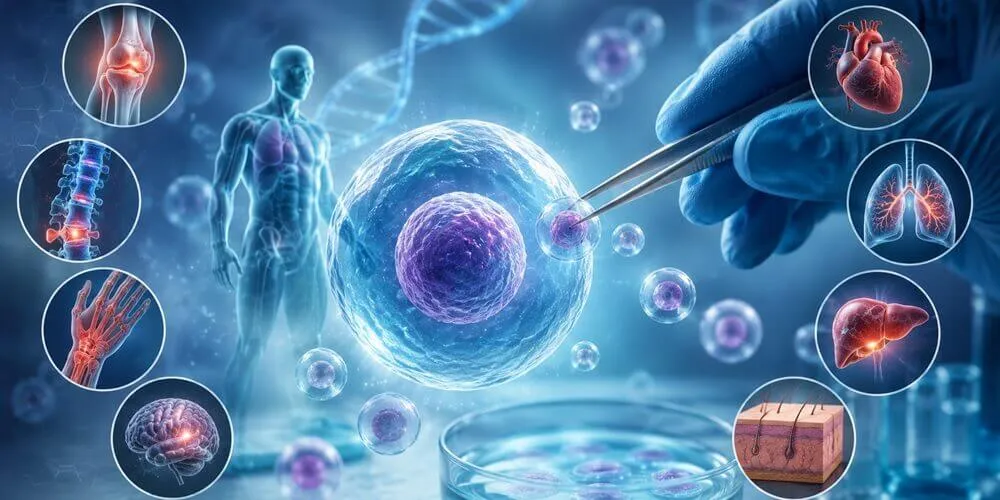
Standardizing, manufacturing, scaling, and producing stem cells at low cost with high efficacy to generate cells for stem cell therapy; addressing unmet medical needs; advances in stem cell technology, invigorating regulations, and patient demand; and the ability of stem cell therapy to fill niche where existing treatments proved limited have generated renewed interest in stem cell therapy research 2026. Evidence from recent reviews, clinicaltrials.gov, and WHO-ICTRP data corroborate these drivers.
What motivates stem cell science in 2026?
The regenerative medicine research therapies to correct damage caused by injury or disease has gained renewed interest. Regenerative medicine approaches harnessing stem cells have garnered particular attention. Cell-based therapies are one of several strategies explored under regenerative medicine that also include the use of biomaterial scaffolds and delivery of genetically modified cells. The ability to regenerate tissues with such approaches, rater than relying on pharmacological agents or prosthesis to substitute the damaged tissue, is a key objective for regenerative medicine. Progress in biomaterials, such as a better understanding of the interaction of stem cells with the microenvironment, making on-demand biomaterials with 3D printing technology, and advances in personalized medicine linked to patient-specific stem cells have strengthened the prospects for cell-based regenerative medicine. A critical experimental and clinical target is a functional restoration achieved with durable outcomes—meaning that once repaired the tissue does not degenerate or require repopulation for a long time.
In parallel with the general trend for biomedical engineers and clinicians to either significantly improve or develop new regenerative medicine approaches to treat diseases that remain poorly addressed by existing therapeutic options, exploratory and proof-of-principle studies with stem cells or methods derived from stem cells have moved into more advanced phases overall. The outcome of these efforts may affect directly the feasibility of translating stem cell technology into safer, robust, and larger-scale therapeutic protocols for unmet medical needs, as remained priority gaps addressed by the stem cell community.
Which conditions studied with stem cell therapy?
Active investigations into stem cell therapy target several neurological, cardiac, autoimmune, and joint conditions. Specific indications that feature prominently include spinal cord injury, stroke, Parkinson’s disease, multiple sclerosis, osteoarthritis, heart failure, and type 1 diabetes. Conditions studied with stem cell therapy adjacent to cancer are also examined, along with developmental and regenerative approaches, in which stem cells play complementary or auxiliary roles. The objectives pursued span disease modification, tissue repair, and immune modulation.
Research efforts in stem cell therapy for neurological disorders are focused on conditions studied with stem cell therapy with a clear tissue-repair rationale. Spinal cord injury, stroke, and Parkinson’s disease are undergoing stem cell clinical trials 2026, while multiple sclerosis is the subject of a pioneering stage 2 study. Key differences in underlying pathophysiology influence treatment targeting, cellular delivery, and safety considerations. In stroke, the inability of cannulated extracellular vesicles to cross the blood-brain barrier necessitates alternative methods for cell passage. The ongoing phases of the respective trials reflect expectations for eventual improvement in mobility, cognition, and seizure risk. In autoimmune diseases, stem cell therapy is being assessed primarily for multiple sclerosis. A reduced incidence of autoimmune flare-ups is anticipated, and the prevention of graft rejection is a principal motive behind cord blood administration. Additional safety data are also sought, given uncertainties surrounding the use of immunosuppressive agents.
How do clinical trials shape stem cell therapy research in 2026?
Phase, comparator, and outcome designs delineate clinical trial pathways for stem cell therapy towards safety and efficacy. Collaborator networks strengthen recruitment, monitor adverse events, and disclose treatment-associated risks. Regulatory frameworks outline processing benchmarks for cellular products and surveil manufacturing integrity.
Stem cell clinical trials 2026 propel clinical research and usher new treatments into practice. First-in-human trials in patients with terminal diseases for novel, unproven or high-risk interventions without standard therapeutic alternatives (even outside of orphan indications) should be based on stringent ethical requirements. They aim to generate enough evidence on safety and tolerability to justify potentially offering the experimental treatment to patients in subsequent phases with less urgent medical need, even those with more favourable prognosis and chance of recovery from the disease.
Almost all phase I–III completed or ongoing stem cell clinical trials 2026 have reported participant motivation in trial registries. For the most advanced experimental interventions in the state of the art, achieving convincing evidence of actual efficacy remains an outstanding hurdle, notably in the absence of controlled studies. The possibilities offered by regenerative medicine–based approaches for respective pharmacological correction of CNS disorders, similar cell-based therapies being targeted at tackling various CNS pathologies, shared challenges in restoring functional integrity of impaired systems and CNS aspects generally have led distinct lines of clinical research to converge on complementary therapeutic strategies.
What role do regenerative medicine research play in 2026?
Regenerative medicine research is a multidimensional and multidisciplinary field that focuses on restoring not only the structure, but also the function and stability of damaged and lost tissues or organs. Among the numerous implemented regenerative medicine treatments, the one based on stem cells has attracted the greatest attention and focus in recent years. Research and clinical applications regarding stem cell therapies have progressed rapidly, yet they differ enormously in scientific integrity and treatment efficacy. The overall aim of these endeavours is to restore lost or damaged tissue in a disease-specific manner. Stem cell therapies form only a portion of the entire regenerative medicine field. Other methodologies aim to combine implantable scaffolds/tissues with stem or differentiated cells, to use stem cells as supporting materials to regenerate distant tissues, or to employ biomaterials capable of delivering drugs or promoting the self-regeneration of the target tissue. In recent years, various investigations have attempted to link stem cells with 3D printing technologies or personalised medicine. In addition to traditional regenerative indices such as physical movement, cognition, and seizure risk, recent studies have begun to survey patient experiences with these therapies in a more holistic manner.
Regenerative medicine strategy aims to repair and replace damaged or lost tissues and organs using cell-based technology, biomaterial scaffolds, or gene-modified cells. These approaches are rapidly developing in parallel with the fields of biomaterials, 3D printing and personalised medicine. The final goal of regenerative medicine is to provide patients with tissues or organs that function properly, whose life time in the body is considerably longer than that of conventional transplants and require minimal or no medication. As the main purpose of regenerative medicine is to restore lost functions and life stability in specific diseases, the functional endpoints in these therapies have become the main criteria for the evaluation of their effects. Nevertheless, the evaluation of regenerative medicine research strategies is not only limited to functional restoration, but should also take account of the quality of life of patients after surgery, so as to comprehensively assess the efficacy of these therapies in the functional niche. Such patient-centred evaluations are particularly necessary when disease-modifying effects are largely absent or inaccessible to current stem cell products or applications.
What are the prospects for stem cell therapy for neurological disorders and autoimmune diseases?
Investigators continue to pursue stem cell-based therapies for both neurological disorders and autoimmune diseases. These two areas differ greatly in the underlying mechanisms and strategies used in the development of new treatments, modes of delivery, and predicted outcomes. In stem cell therapy for neurological disorders such as spinal cord injury and Parkinson’s disease, the aim is to restore normal cellular composition and function in the target tissue. In autoimmune diseases such as multiple sclerosis and type 1 diabetes, a therapeutic goal is to reinstate self-tolerance toward an endogenous antigen. Although stem cells serve as a repair mechanism to replenish damaged cells in the case of neurological disorders, they represent a novel means of modifying immune dysregulation in related stem cell therapy for autoimmune diseases.
The near-term treatments are expected to reduce motor and cognitive deficits in several neurological disorders, ameliorate seizure risk in temporal lobe epilepsy, and control the frequency and severity of flares in several stem cell therapy for autoimmune diseases. Technical challenges remain, such as the delivery of restorative cells across the blood-brain barrier, overcoming graft rejection and secondary autoimmune complications, and substantiating the long-term safety of the graft via its effect on the other auto-aggressive elements of the disease.
How do emerging stem cell treatments 2026 compare to earlier efforts?
Multiple factors differentiate investigational stem cell therapies in 2026 from previous efforts. New production methods enhance safety and scalability while diversifying available cell sources. Individualized manufacturing processes are becoming less requisite. Many therapies feature favorable safety profiles, with patient-reported outcomes suggesting enhancements in quality of life. Nevertheless, questions about efficacy, standardization, and regulatory approval remain.
Innovations in trial design further characterize contemporary investigations. Adaptive approaches enable real-time refining of protocols, including treatment components, dosing regimens, and patient selection criteria. Compassionate-use applications document safety and functional impact in patients with urgent medical needs. Collaborating networks such as the Curative Medicine Collaborative facilitate evidence generation and translation for virtually any hematological or solid-organ disease, including COVID-19.
Conclusion
Over the past 150 years, stem cell medicine has steadily developed from concept to practice, gaining capabilities, safety, acceptance, and efficacy along the way. These advancements are being driven by patient demand and parallel progress in academic stem cell research, tissue repair, regenerative medicine, and biomaterials. Addressing pressing needs with a transformative patient-centered approach, stem cell science is pioneering innovative trial designs, community engagement, and compassionate use.
As demand grows for safe and effective stem cell clinical trials 2026, so too does the responsibility to deliver on these investments. For all the delivery innovations in place, the data must be generated, published, and shared in a way that maximizes both reproducibility and learning in the field. Collaborative trial networks, registries, and open-data approaches are critical to this undertaking, especially when combined with adaptive trial designs. Transparent data sharing encourages external sponsors to support postmarketing studies, making it possible for patients to be treated off-label sooner rather than later.